

A Psychiatrist's 2026 Depression Playbook

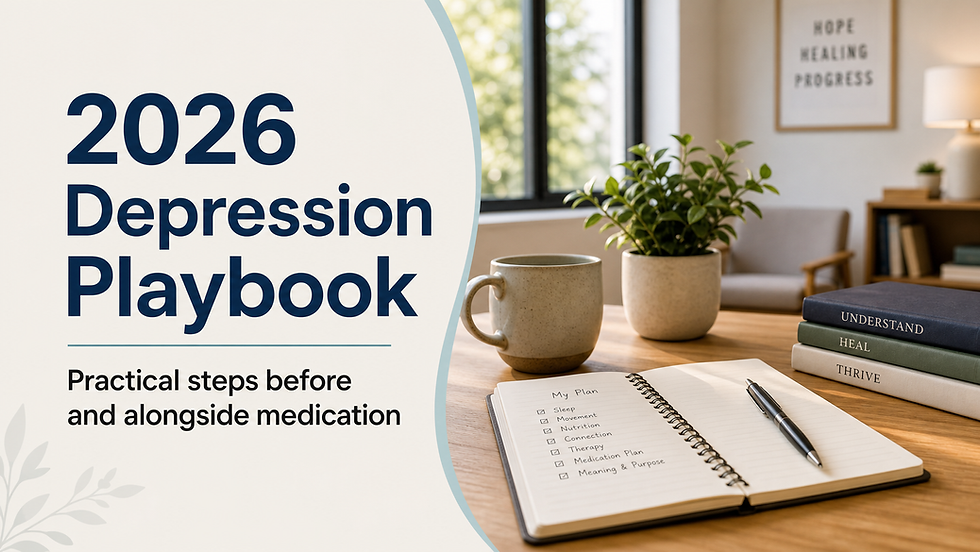
If a psychiatrist began building a depression playbook tomorrow, the first step would not be to grab the nearest prescription pad. It would be to assess severity, safety, function, sleep, history, and the practical supports that can actually hold a recovery plan together.
That distinction matters. Medication can be life-changing and sometimes urgent. But for many people with mild to moderate depression, a complete plan includes several evidence-informed steps before, alongside, or after medication. At Sophroneo Behavioral Health & TMS, depression care is strongest when it treats the whole pattern: mood, sleep, activity, medical history, stress, relationships, and access to the right level of support.
This article is educational and is not a substitute for a diagnosis or treatment plan from a licensed clinician. If you have thoughts of suicide, thoughts of harming yourself, or feel unable to stay safe, call or text 988 in the U.S. or go to the nearest emergency department.
First, a psychiatrist would check risk and severity
The most important first question is not "Which medication?" It is "How serious is this episode?"
Depression exists on a spectrum. A person who feels low, withdrawn, and unmotivated but can still work, eat, sleep, and stay safe needs a different plan from someone who cannot function, is losing weight rapidly, feels detached from reality, or is thinking about suicide.
A psychiatrist would usually sort the situation into a few practical buckets:
Mild to moderate symptoms with preserved safety and some functioning.
Moderate to severe symptoms with major impairment.
Recurrent depression, especially after multiple past episodes.
Depression with possible bipolar disorder, psychosis, substance use, trauma, ADHD, anxiety, or a medical contributor.
Any level of depression with suicidal thoughts, plan, intent, or inability to stay safe.
This is why a real depression evaluation matters. The goal is not to label someone quickly. The goal is to understand the pattern well enough to choose the right first move.
The non-medication tools psychiatrists take seriously
The phrase "lifestyle change" can sound dismissive when someone is depressed. That is not what this section means. These are not moral pep talks. They are structured interventions that can change the biology and behavior loops that keep depression going.
Exercise: the most under-prescribed antidepressant-like intervention
Exercise is not a cure-all, but it has unusually strong evidence for depressive symptoms. A major BMJ network meta-analysis found that several forms of exercise, especially walking or jogging, yoga, and strength training, were associated with meaningful reductions in depression symptoms and may be used alongside psychotherapy or medication when appropriate (BMJ).
A psychiatrist would not tell a depressed person to "just work out." They would lower the starting line until it becomes possible. Ten minutes of walking counts. Standing outside in morning light counts. Repeating a tiny routine matters more than chasing intensity.
The point is consistency. Depression shrinks behavior. A good plan widens it again.
Behavioral activation: action before motivation
Behavioral activation is one of the most practical tools in depression care. It starts with a blunt observation: depression pushes people to withdraw, and withdrawal deepens depression. The way out is not always to wait until motivation returns. Often, action has to come first.
That may mean scheduling one values-based activity per day, even if it feels small: a shower, a short walk, a call with a trusted person, a meal, a therapy appointment, or 15 minutes of cleaning one corner of a room.
If you are not sure whether what you are experiencing is depression, burnout, anxiety, or something else, this guide on what to expect during a depression evaluation can help you prepare for a more useful clinical conversation.
Sleep: the foundation that depression often steals first
Sleep and depression reinforce each other. Poor sleep can worsen mood, concentration, appetite, irritability, and motivation. Depression can also make sleep fragmented, excessive, delayed, or unrefreshing.
A psychiatrist would look closely at sleep timing, insomnia, nightmares, early-morning awakening, sleep apnea risk, alcohol use, stimulant timing, and screen patterns. For some people, improving sleep is not a side quest. It is the floor of the whole plan.
If insomnia is part of the picture, Sophroneo's insomnia care can be a relevant place to start alongside depression treatment.
Social connection: not scrolling, actual contact
Depression often says, "Do not answer. Do not go. Do not tell anyone." A recovery plan has to account for that.
The useful version of social support is not constant socializing. It is dependable contact. One trusted person. One check-in. One voice conversation. One place where you do not have to perform being fine.
For many people, depression also overlaps with anxiety symptoms, attention problems, or shutdown patterns that make connection harder. When mood and focus issues overlap, it can also be worth asking whether ADHD care belongs in the evaluation.
When medication should move up the list
None of this means antidepressants are "bad" or that medication should be delayed when it is clearly needed.
Medication may be an early or immediate part of care when depression is severe, recurrent, biologically intense, or functionally disabling. Examples include persistent inability to work or care for yourself, significant appetite or weight change, severe insomnia or hypersomnia, psychomotor slowing, repeated depressive episodes, family history of strong medication response, or suicidal thoughts.
Medication is also not the only advanced option. When depression has not responded to standard approaches, a psychiatrist may discuss treatment-resistant depression options such as Spravato, ketamine-related care, or TMS depending on the person's diagnosis, safety profile, and history. Sophroneo offers care pathways that include a Spravato specialist, information about ketamine and Spravato treatment for depression, and NeuroStar TMS for eligible patients.
The honest point is this: medication is a tool, not a personality test. Needing it does not mean you failed at lifestyle changes. Not needing it immediately does not mean your depression is not real.
How Sophroneo helps turn a depression playbook into care
A depression playbook is useful only if it becomes specific to the person using it. Through Sophroneo's mental health services, patients can move from general advice to a plan that considers diagnosis, medical history, medication options, sleep, safety, and treatment access.
For some patients, the next step is therapy support and medication discussion. For others, it may be learning how TMS works, exploring whether TMS is a fit, or reviewing warning signs that it may be time to schedule a psychiatric evaluation.
Build the plan before crisis hits

The worst time to design a depression plan is when depression has already taken over your energy, memory, confidence, and decision-making.
Build the plan while you can still think clearly.
Tier 1: The minimum behavioral floor
This is not the ideal wellness routine. It is the lowest routine that keeps the spiral from getting worse.
Examples:
One 10-minute walk per day.
One real meal.
One consistent wake time.
One shower or hygiene step.
One message to a trusted person.
One appointment kept.
Tier 2: The provider you already know how to reach
Do not wait until a bad episode to figure out who to call. Keep the practice name, phone number, portal, and appointment link somewhere easy to find. For many people, this can include telehealth access, in-person psychiatric care, or both.
The Sophroneo homepage is a simple place to return when you need to reconnect with the practice, services, or next steps.
Tier 3: The trusted person with a defined role
Choose one or two people who can check in if you disappear, stop answering, or sound unlike yourself. Their role is not to fix depression. Their role is to help you stay connected and help you follow the plan when your brain starts arguing against it.
Tier 4: Your medication position, decided before panic
You do not have to decide today that you will or will not take medication. But it helps to know your threshold.
For example:
"If I cannot work for more than a week, I will ask about medication."
"If suicidal thoughts appear, I will contact a clinician immediately."
"If this becomes my third episode, I will not wait months to seek treatment."
"If two treatments fail, I will ask about options beyond standard antidepressants."
If you are weighing advanced options, this comparison of ketamine, Spravato, TMS, and antidepressants may help you prepare better questions for your clinician.
Tier 5: Crisis clarity
Passive thoughts like "I wish I would not wake up" are serious and deserve prompt clinical attention. Active suicidal thoughts with a plan, intent, or access to means are an emergency. In the U.S., call or text 988 or go to the nearest emergency department.
Do not wait to become "sure enough" that it is serious. If safety is uncertain, treat it as urgent.
Video context: This NIMH Mental Health Minute gives a short, plain-language overview of depression symptoms and why reaching out for help matters.
The bottom line
A psychiatrist's 2026 depression playbook is not anti-medication. It is anti-oversimplification.
Depression care works best when it starts with the right question: What level of support does this person need right now?
Sometimes the answer is exercise, behavioral activation, sleep repair, social connection, and therapy. Sometimes the answer includes medication from the beginning. Sometimes the answer is urgent safety support. Sometimes the answer is a deeper evaluation because depression is only one piece of a more complicated picture.
The real win is not choosing one camp. It is building a plan that can survive the days when motivation disappears.
Frequently asked questions
Why would a psychiatrist not start with medication immediately?
Because the first decision depends on severity, safety, history, and function. For mild to moderate depression without emergency features, structured behavioral changes, therapy, sleep intervention, and social support may be appropriate first steps or concurrent steps. For more severe or recurrent depression, medication may move up much earlier.
Does this mean antidepressants do not work?
No. Antidepressants can be helpful and sometimes necessary. The point is that medication works best when it is matched to the right diagnosis, severity level, and broader care plan.
What is behavioral activation?
Behavioral activation is a therapy approach that helps people reverse the withdrawal cycle of depression. Instead of waiting to feel motivated, the person schedules small, meaningful actions first. Mood improvement often follows repeated action.
How much exercise helps depression?
Many guidelines use 150 minutes of moderate activity per week as a general target, but that can be too much at the beginning of a depressive episode. Starting with 10-minute walks and building consistency is often more realistic.
When is depression an emergency?
Depression is an emergency when someone has active suicidal thoughts, a plan, intent, access to means, psychotic symptoms, inability to care for basic needs, or feels unable to stay safe. In the U.S., call or text 988 or go to the nearest emergency department.
How do I know whether I need medication?
Medication may be more likely when depression is moderate to severe, recurrent, disabling, biologically intense, or not improving with structured non-medication care. A psychiatric evaluation is the right place to make that decision with your history and safety in mind.


Comments