

How to Build an ADHD Morning Routine That Actually Works
- Sophroneo Psychiatry

- Apr 14
- 7 min read
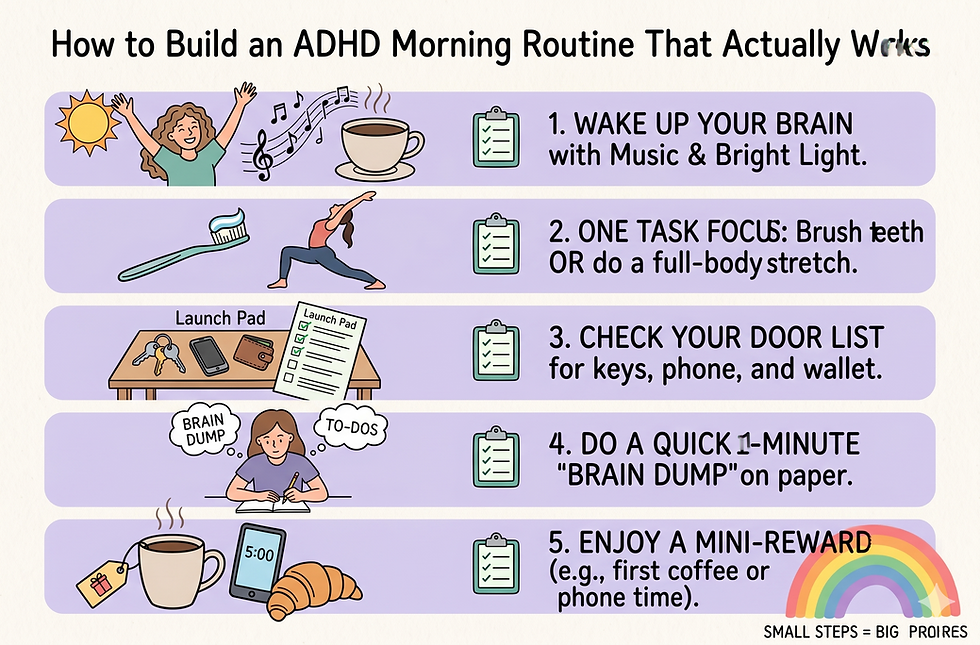
You have likely downloaded the productivity apps. You have probably set multiple alarms staggered five minutes apart. You may have even tried color-coded journals to force a sense of order onto your early hours. Yet many people find themselves lying in bed long after their alarm goes off, caught in a mental fog and wondering why they cannot just get up.
There is a clinical reason for this struggle. Standard productivity advice is designed for neurotypical brains. The self-help industry builds schedules for brains that transition smoothly from sleep to wakefulness and can execute multi-step sequences easily. Attention-Deficit/Hyperactivity Disorder changes how the brain initiates tasks. Once you stop pretending your brain should work like a neurotypical one, you can begin building an ADHD morning routine that actually supports your daily life.
Why Do Traditional Schedules Fail the ADHD Brain?
Waking up is not a single event. It is a biological process that happens much slower for individuals with ADHD. Research from organizations like the National Institute of Mental Health highlights that ADHD involves dysregulation in the dopamine and norepinephrine systems. These are the specific neurotransmitters responsible for arousal, alertness, and motivated action.
When a neurotypical brain wakes up, these systems climb quickly toward a functional baseline. When an ADHD brain wakes up, that climb is often sluggish and uneven. The result is a measurable difference in cortical activation.
Consider executive function, which is the cognitive skill set that helps you plan, initiate tasks, and shift between activities. Executive dysfunction is a core feature of ADHD. Mornings are essentially a series of executive function demands fired in rapid succession. You must wake up, remember the day's obligations, choose what to wear, and prepare breakfast. Every single micro-task requires initiation. Initiation is exactly where the ADHD brain struggles most.
Real-World Scenario: Imagine an adult staring at their closet for ten minutes unable to pick a shirt. This is not a personality flaw. It is decision fatigue hitting a brain that has not fully "booted up" yet.
Additionally, many people with ADHD experience Rejection Sensitive Dysphoria, meaning they feel failure with unusual intensity. Starting the day by failing at a strict, minute-by-minute schedule often triggers a shame cycle that derails the entire afternoon.
What Does a Functional ADHD Morning Routine Look Like?
The architecture of a functional ADHD morning routine relies on reliable touchpoints rather than strict timelines. These touchpoints guide the brain from sleep to function without demanding excessive willpower.
Start With One Meaningful Alarm
Multiple alarms train your brain to ignore the sound completely. They also fragment your sleep in the final hours, leaving you more cognitively impaired. Pick one alarm at a consistent time. Place your phone across the room so getting out of bed is physically required. This reduces the decision load at the exact moment your executive function is most depleted.
Build a Launch Sequence Instead of a Timetable
A standard schedule dictates exact times for brushing teeth and making coffee. A launch sequence simply dictates the order of operations without attaching specific minutes. People with ADHD frequently struggle with time blindness, making clock-based schedules a setup for failure. A sequence of anchors removes the clock from the equation. Your plan becomes "movement happens after coffee" rather than "workout exactly at 7:00 AM."
Eliminate Early Morning Decisions
Decision fatigue drains the finite cognitive reserve you need for the rest of the day. Aggressive pre-decision is highly effective for an ADHD morning routine. Lay out your clothes the night before. Keep breakfast options limited to two rotating choices. Set your coffee maker on an automatic timer.
Use Body-Doubling for Task Initiation
Body-doubling is the phenomenon where having another person present dramatically improves focus and task initiation. You do not need someone physically in the room. Putting on a favorite podcast, a YouTube video, or a virtual co-working stream can provide the external stimulation necessary to trigger activation. Pair this audio with physical tasks like getting dressed to help your brain engage.
Real-World Scenario: A college student struggles to get out of bed in a quiet room. By setting a smart speaker to play an engaging, high-energy podcast at 8:00 AM, the student receives the external dopamine boost needed to stand up and walk to the bathroom.
How Can You Recover When Your Morning Goes Wrong?
Routines will inevitably break down. The way you handle that disruption determines whether one bad morning turns into a lost week.
Adapt the Never Miss Twice Rule: If you miss your morning sequence yesterday, today's version does not need to be the full routine. Complete a minimum viable version, such as achieving just one anchor. You are simply re-establishing the neural pathway with zero pressure.
Audit the Shame Spiral: When a morning goes sideways, focus on how fast you recover from the negative emotions. An ADHD morning routine that starts late but involves functional emotional regulation is significantly more useful than an early morning that unravels into panic.
Create a Reset Ritual: Design a short sequence you run when a morning falls apart. Drink a glass of water, open a window, and write down one single task for the next hour. This interrupts the shame spiral and creates a micro fresh-start.
Assumptions and Limitations of Routine Planning
Before overhauling your mornings, it helps to understand the realistic boundaries of routine planning:
Routines do not cure ADHD symptoms. They are structural supports designed to lessen daily friction.
What works perfectly for one month may suddenly stop working due to a natural drop in dopamine interest. Rotating your routine anchors is a normal and necessary practice.
Co-occurring conditions like insomnia, anxiety, or depression can heavily impact morning energy levels, requiring distinct clinical interventions.
How Does Sophroneo Behavioral Health Support ADHD Management?
While structural changes at home are valuable, professional support often provides the foundation needed for long-term symptom management. Sophroneo Behavioral Health offers comprehensive behavioral health care options for children, adolescents, adults, and families struggling with ADHD.
Many clinics only offer medication management, while others only offer therapy, leaving patients to piece together their own care plan. Integrated care provides a more unified, less frustrating approach. Options available at Sophroneo include:
Psychiatric Evaluations: Comprehensive assessments to clarify your diagnosis and guide next steps.
Medication Management: Psychopharmacology services to help address the underlying dopamine and norepinephrine dysregulation safely.
Individual Therapy: Evidence-based approaches, including Cognitive Behavioral Therapy, to help build executive function skills and manage the emotional impact of ADHD.
Telepsychiatry: Virtual mental health services that allow patients to receive care from home, removing the friction of morning travel for appointments.
Building a sustainable ADHD morning routine means designing around your neurological differences instead of fighting them. With the right tools and appropriate clinical support, you can experience a morning that actually helps you start the day.
Comparison/Table:
Feature | Standard Morning Routine | ADHD-Friendly Morning Routine |
Structure | Clock-based and rigid (e.g., 6:00 AM wake, 6:15 AM stretch). | Sequence-based and flexible (e.g., coffee, then stretch). |
Alarms | Multiple staggered alarms to encourage waking up slowly. | One single alarm placed across the room to force physical movement. |
Task Order | Front-loads difficult tasks (exercise, meditation) to build discipline. | Front-loads high-interest tasks (music, favorite breakfast) to build dopamine. |
Decision Making | Deciding outfits, breakfast, and priorities in the moment. | Pre-deciding all basic choices the night before to save executive function. |
Failure Response | Missed steps create a sense of failure and abandoned routines. | Missed steps trigger a "micro-reset" focused on emotional recovery. |
Troubleshooting:
Concern: You continuously hit snooze and sleep through your designated wake time.
Likely Explanation: Your brain lacks the immediate dopamine required to transition from sleep to wakefulness, or you are experiencing delayed sleep phase issues.
What to do next: Move the physical alarm out of arm's reach. Pair the alarm with an automatic light turning on or a favorite fast-paced song playing to increase external stimulation.
Concern: You get out of bed but immediately get distracted by your phone for an hour.
Likely Explanation: The brain is seeking quick dopamine hits. Passive scrolling spikes stimulation but makes sustained focus harder afterward.
What to do next: Do not ban the phone entirely. Instead, use the phone intentionally. Turn on a podcast or audio-book, place the phone in your pocket, and let the audio play while you complete a physical task like making the bed.
Concern: You complete the routine for two weeks, and then suddenly cannot do it anymore.
Likely Explanation: The novelty has worn off. ADHD brains require novelty to generate dopamine.
What to do next: Change one variable in the routine. Switch your breakfast option, change your morning playlist, or alter the order of your launch sequence to reintroduce a sense of newness.
Frequently Asked Questions:
What is the best time to start an ADHD morning routine?
There is no single best time. Because many individuals with ADHD naturally have a delayed sleep phase, forcing a 5:00 AM wake time can be counterproductive. The best time is one that allows you to get adequate sleep and provides enough buffer time before your first mandatory obligation of the day.
Can an ADHD morning routine help with emotional regulation?
Yes. By reducing decision fatigue and eliminating the rush of a chaotic morning, you preserve your executive function for later in the day. Preventing the morning shame spiral directly supports better emotional stability throughout the afternoon.
How does medication fit into an ADHD morning routine?
For those who are prescribed stimulant medications, timing is an important factor. Many patients find it helpful to take their medication immediately upon waking, using the 20 to 30 minutes it takes to become active as their low-demand "buffer zone." Always follow the specific instructions provided by your prescribing clinician.
Why do I feel paralyzed when I have too much time in the morning?
ADHD brains often struggle to initiate tasks without a sense of urgency. Too much unstructured time can lead to "waiting mode" or task paralysis. Using a structured launch sequence helps bridge the gap between waking up and feeling the urgency of the day.
Is it normal to constantly change my morning habits?
Absolutely. Expecting a habit to become permanent forever is unrealistic for an ADHD brain that thrives on novelty. Rotating your strategies is a normal, healthy way to keep your brain engaged with the process.
Can therapy help me build better daily systems?
Yes. Working with a therapist who understands neurodivergence can help you identify your specific friction points. Therapists can assist in developing personalized strategies and addressing the anxiety or shame that often accompanies executive dysfunction.


Comments