

The Difference Between Jealousy, Envy, and Resentment
- Sophroneo Psychiatry

- Jan 3
- 7 min read
Updated: Jan 4
Jealousy can feel embarrassing, confusing, or even scary, especially when it surfaces in relationships you value deeply. If you are searching to define jealousy, you are likely trying to figure out if what you are feeling is "normal," what it means about your relationship, and how to handle it without pushing people away.
In this guide, you will find:
A clear definition of jealousy in simple terms and psychology.
A decision matrix to tell jealousy apart from envy, resentment, and disrespect.
The 6 common types of jealousy and their triggers.
A calm, step-by-step reset tool you can use immediately.
Guidance on when to seek professional support from a behavioral health expert.
What is jealousy in simple terms?
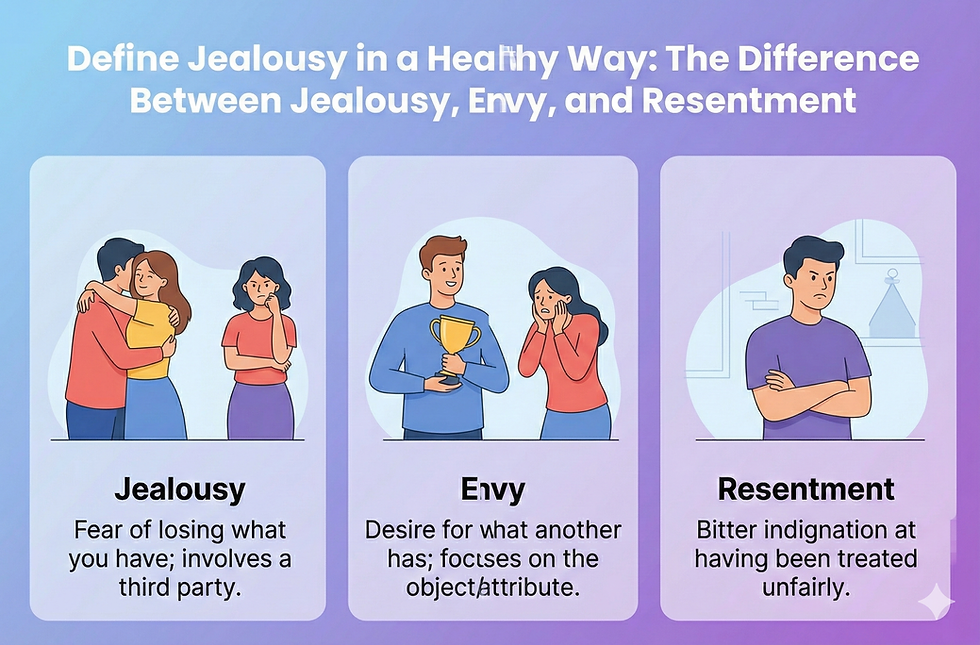
Jealousy is a threat response that occurs when you fear losing a valued connection, status, or "place" to someone else.
It almost always involves a triangle: You, something or someone you value, and a perceived rival. That rival could be a person, a job, a hobby, or even a version of life you feel someone else is taking away from you. Jealousy is not just "being dramatic." It is your brain trying to reduce uncertainty and protect what matters to you.
What is jealousy in psychology?
In psychology, jealousy is commonly described as a complex emotion triggered by a perceived threat to a valued relationship or quality.
The American Psychological Association (APA) notes that jealousy involves resentment toward a third party who appears likely to take away affection or attention. This definition is helpful because it highlights the "rival" element, which distinguishes jealousy from general insecurity.
Key psychological concepts:
Protection mechanism: Jealousy is evolutionarily designed to protect social bonds.
Secondary emotion: It is often a mix of primary emotions like fear, anger, sadness, and shame.
Cognitive distortion: It often involves "mind-reading" (assuming you know what others are thinking).
Is jealousy the same as envy?
No, they are different emotions, though they often happen together.
Envy is about wanting what someone else has (and you lack).
Jealousy is about fearing you will lose what you already have.
Example:
Envy: "I wish I had her career success."
Jealousy: "I am afraid my partner admires her success more than mine, and I will lose his attention."
How is jealousy different from resentment or feeling disrespected?
Jealousy fears loss to a rival, resentment holds onto unfairness, and feeling disrespected centers on violated dignity. Distinguishing these is vital because the solution for each is different.
Decision Matrix: What Am I Actually Feeling?
Emotion | Core Concern | The "Voice" in Your Head | Best Next Step |
Jealousy | Losing connection or priority to a rival. | "I'm being replaced." | Reassurance + Self-Soothing |
Envy | Lacking a trait/item someone else possesses. | "Why don't I have that?" | Self-Compassion + Goal Setting |
Resentment | Unfairness or unmet needs over time. | "I keep giving and getting nothing back." | Repair Conversation + Renegotiation |
Disrespect | Dignity, safety, or values violated. | "That crossed a line." | Boundary Setting + Consequences |
What are the signs of jealousy?
Jealousy often shows up as anxious thoughts, physical tension, and specific behaviors designed to "check" for safety.
Common signs include:
Physical: Racing heart, shallow breathing, stomach knots, or feeling hot.
Emotional: A mix of anxiety, anger, and humiliation.
Behavioral: Checking a partner's phone, constantly asking for reassurance ("Do you still love me?"), analyzing social media activity, or acting cold/withdrawn to protect yourself.
Which types of jealousy do people commonly experience?
While jealousy is a universal human experience, it manifests differently depending on the context. Identifying the "type" can help you find the right solution.
Romantic Jealousy: The fear of losing a partner's intimacy or commitment to a rival.
Friendship Jealousy: Fearing you are being "replaced" as a best friend or are being left out of a group.
Family/Sibling Jealousy: Rivalry for a parent’s attention, approval, or perceived fairness in treatment.
Workplace Jealousy: Fear of losing status, recognition, or a promotion to a colleague.
Social Comparison Jealousy: The fear that your social value drops when others in your circle "outshine" you.
Pathological (Obsessive) Jealousy: A severe form where irrational accusations and checking behaviors persist despite no evidence. This may be linked to underlying mental health conditions like OCD, paranoia, or alcohol use disorders.
What triggers jealousy and why does it feel so intense?
Jealousy is often triggered by uncertainty, past hurts, low self-esteem, or attachment insecurity.
Your brain processes social rejection in the same regions that process physical pain. That is why jealousy physically hurts.
Common Triggers:
Ambiguity: Mixed signals or undefined relationship status.
The "Highlight Reel": Social media feeds that create unrealistic comparisons.
Past Trauma: Previous betrayal or abandonment makes you hyper-vigilant to new threats.
Insecurity: A core belief of "I am not good enough" makes every rival look dangerous.
Trigger Tracker Checklist:
[ ] What exactly happened (just the facts)?
[ ] What story did my mind create immediately?
[ ] What am I afraid of losing (love, status, respect)?
[ ] Is this fear based on now or the past?
How do I know if I’m being jealous or setting boundaries?
Boundaries protect your wellbeing with clear limits; jealousy tries to manage anxiety by controlling others.
The Distinction:
Boundary: "I am not comfortable with you sharing our private arguments with your ex. If that continues, I won't share personal things with you." (Focuses on your action).
Jealousy/Control: "You are not allowed to talk to your ex because it makes me nervous." (Focuses on controlling their behavior).
How can I manage jealousy in the moment?
You can manage jealousy by naming it, calming your body, and separating facts from fears.
The 10-Minute Reset:
Name It: Say, "I am feeling jealous right now." This engages your prefrontal cortex.
Pause: Do not send that text. Do not check that phone. Wait 10 minutes.
Breathe: Take 5 deep breaths to lower your heart rate.
Fact-Check: Write down what you know is true vs. what you fear might be true.
Ask: Do I need reassurance (comfort) or clarity (information)? Ask for that directly.
When does jealousy become toxic or obsessive?
Jealousy becomes unhealthy when it drives repeated accusations, monitoring, isolation, threats, or persistent distress.
If you find yourself stuck in loops of checking, accusing, and momentary relief followed by more suspicion, this may be a sign of obsessive jealousy. In some cases, this can be related to Obsessive-Compulsive Disorder (OCD) (where the obsession is the relationship and the compulsion is checking/asking) or severe anxiety.
Troubleshooting: The Jealousy Loop
If you notice this loop... | It likely means... | Try this instead... |
Reassurance Seeking (Asking "Are we okay?" 10x a day) | You are trying to eliminate all uncertainty. | Ask once, then practice tolerating the uncertainty. |
Digital Checking (Monitoring locations/likes) | You are feeding the "threat" center of your brain. | strict "No Check" boundaries for 24 hours. |
Accusations ("I know you looked at them") | You are projecting your fear as fact. | Use "I feel" statements: "I feel insecure when..." |
Safety Note: If jealousy escalates to threats, stalking, physical aggression, or makes you feel unsafe, this is not a relationship issue, it is a safety issue. Please contact domestic violence resources or emergency services (911) immediately.
When should I consider professional support?
Consider support when jealousy harms your relationships, your sleep, your ability to focus, or your sense of self-worth.
Sometimes, "jealousy" is actually a symptom of a treatable underlying issue, such as generalized anxiety, OCD, trauma (PTSD), or depression.
How Sophroneo Behavioral Health & TMS fits:
If you live in the Atlanta metro area (including Powder Springs and Stone Mountain), Sophroneo offers an integrated approach to mental health that goes beyond just "talking it out."
Comprehensive Evaluation: A clinician can help determine if your jealousy is rooted in attachment issues, trauma, or a condition like OCD or anxiety.
Therapy: Evidence-based approaches like CBT to help reframe thoughts and build self-esteem.
Medication Management: If biochemical factors (like severe anxiety) are fueling the jealousy, medication may help stabilize your mood.
Telepsychiatry: Access care from the privacy of your home.
You do not have to "white-knuckle" these feelings alone. Understanding the root cause is the first step toward relief.
Assumptions & limitations
Not Medical Advice: This article is for educational purposes. It does not replace a diagnosis from a licensed professional.
Context Matters: Jealousy can be a rational response to actual betrayal. Professional guidance helps distinguish reasonable suspicion from irrational fear.
Individual Results: Healing from deep-seated jealousy often requires time and active participation in therapy.
Frequently Asked Questions:
1. What is the simple definition of jealousy?
Jealousy is a protective emotion that arises when you fear losing a valued relationship or position to a rival. It usually involves a mix of fear, anger, and insecurity.
2. Is jealousy a sign of love?
Not necessarily. While mild jealousy shows you value a relationship, intense or controlling jealousy is usually a sign of insecurity, attachment anxiety, or trust issues rather than love.
3. Can jealousy be cured?
Jealousy isn't a disease to be "cured," but it is an emotion that can be managed. Through therapy and self-work, you can reduce the intensity of triggers and stop the destructive behaviors associated with it.
4. What is the difference between jealousy and envy?
Envy is wanting what someone else has (like their car or confidence). Jealousy is fearing you will lose what you have (like your partner's affection) to someone else.
5. How do I stop being jealous of my partner's past?
"Retroactive jealousy" often stems from current insecurity. Remind yourself that their past led them to you. If obsessive thoughts about their past persist, [Link to: OCD treatment] or therapy can be very effective.
6. Does low self-esteem cause jealousy?
Yes, low self-esteem is a major driver. If you don't feel "good enough," you are more likely to perceive others as threats who could easily replace you.
7. When is jealousy considered "pathological"?
Jealousy is considered pathological or delusional when it persists despite clear evidence to the contrary, involves obsessive checking, or leads to dangerous controlling behaviors.
8. Can medication help with jealousy?
If jealousy is driven by an underlying condition like Anxiety, Depression, or OCD, treating that condition with medication (like SSRIs) or therapy can significantly reduce the jealous thoughts.


Comments